
For an ecommerce business, a drop in organic traffic can feel confusing. Your products are live, your website looks good, and you’re investing in marketing—so why aren’t the right customers finding you?
Often, the problem isn’t your products or your marketing budget. It’s what is happening behind the scenes of your website.
Technical SEO issues can quietly prevent search engines from discovering, understanding, and prioritising your most important pages. And on a large ecommerce website, even a small technical problem can affect hundreds or thousands of URLs.
That is why effective Ecommerce SEO needs to look beyond keywords and content. Your website needs a clean technical foundation that allows search engines to crawl your site efficiently, index valuable pages, and understand your products.
Here are five common performance killers that could be holding your ecommerce website back—and what you can do about them.
The 5 Ecommerce SEO Problems You Shouldn’t Ignore
Before getting into the details, here are the five issues worth checking:
- Important product pages aren’t being indexed
- Crawl bloat is wasting search engine resources
- Over-optimised content is hurting user experience
- Sitemap problems are confusing search engines
- Missing structured data limits product visibility
None of these problems necessarily looks dramatic from the customer’s side. That’s what makes them dangerous.
1. Unindexed Product Pages
If search engines can’t find your products, customers can’t find them either
One of the biggest ecommerce SEO problems is also one of the easiest to overlook: important product pages simply aren’t appearing in Google’s index.
Your product may be available on your website and perfectly functional for visitors, but if Google hasn’t indexed the page, it has very little opportunity to attract organic search traffic.
You may notice signs such as:
- Newly launched products receiving no organic traffic
- Important products disappearing from search results
- Seasonal products failing to gain visibility
- Pages showing indexing problems in Google Search Console
- Product URLs receiving very few or no impressions
Why does this happen?
Several technical and content issues can contribute:
- Product descriptions are too thin or duplicated
- Important pages aren’t linked internally
- Robots.txt or meta directives accidentally block crawling or indexing
- Large websites have inefficient crawl paths
- Product pages are generated dynamically without proper SEO controls
How can you fix it?
Start by checking your important product URLs in Google Search Console. Look at whether they’re indexed and investigate any reported issues.
Then make sure your priority products have:
- Unique and useful descriptions
- Clear internal links from relevant category pages
- Appropriate canonical tags
- A healthy XML sitemap
- Valuable information such as specifications, reviews and availability
Don’t assume that because a product exists on your website, Google automatically understands that it deserves visibility.
2. Crawl Bloat
More URLs don’t mean more SEO value
Ecommerce websites can generate enormous numbers of URLs.
Filters, sorting options, product variants, tracking parameters and old products can create multiple versions of essentially the same page. Search engines may spend time crawling these low-value URLs instead of concentrating on pages that matter to your business.
This is known as crawl bloat.
You might find:
- Hundreds of filter combinations being crawled
- URLs containing unnecessary parameters
- Old or discontinued products still accessible
- Duplicate versions of category pages
- Internal search-result URLs being discovered
- Large numbers of low-value pages in crawl reports
Why is crawl bloat a problem?
Imagine a store with 20,000 URLs, but only 3,000 genuinely important pages.
If search engines repeatedly encounter thousands of unnecessary URLs, your site’s crawl and indexing signals can become less efficient. New products and valuable content may take longer to be discovered or properly prioritised.
What should you do?
A proper technical audit can help identify unnecessary URLs and determine which should be:
- Canonicalised
- Redirected
- Blocked from crawling where appropriate
- Removed
- Consolidated
Faceted navigation should also be reviewed carefully. Filters are excellent for shoppers, but they need to be handled thoughtfully from an SEO perspective.
3. Over-Optimised Ecommerce Content
SEO should help your customers—not make them feel like they’re reading a keyword list
There was a time when repeating a keyword again and again could seem like an SEO tactic.
That approach doesn’t create a good shopping experience today.
If a product description reads like:
“Buy the best men’s shoes online. Our men’s shoes are the best men’s shoes for buying men’s shoes online…”
you have a problem.
Over-optimisation can make content unnatural, repetitive and unhelpful. It can also make your brand look less trustworthy.
Common warning signs include:
- Excessive keyword repetition
- Identical product descriptions across multiple products
- Titles packed with variations of the same keyword
- AI-generated descriptions published without meaningful editing
- Category pages created only to target tiny keyword variations
- Content that answers search engines but doesn’t help shoppers
The better approach
Think about what your customer actually needs before purchasing.
For a product page, that might include:
- Key features
- Benefits
- Materials or specifications
- Size information
- Compatibility
- Shipping details
- Usage instructions
- Genuine customer reviews
- Frequently asked questions
Use keywords naturally where they make sense, but don’t let them dictate every sentence.
Good ecommerce content should make a customer think, “This product is exactly what I was looking for.”
That’s far more valuable than simply making a keyword appear ten extra times.
4. Sitemap Problems
Your XML sitemap is a roadmap—make sure it points to the right places
An XML sitemap helps search engines discover important URLs on your website. But many ecommerce businesses create one automatically through their platform and never check it again.
That’s risky.
Products are added, removed and changed constantly. Categories get reorganised. Old URLs are redirected. Yet the sitemap can remain outdated.
Common sitemap problems include:
- 404 URLs included in the sitemap
- Redirected URLs still listed
- Discontinued products remaining in the sitemap
- Important new products missing
- Filter and parameter URLs being included unnecessarily
- Large, poorly organised sitemap files
A sitemap filled with URLs that shouldn’t be indexed sends mixed signals about which pages are actually important.
How to improve your sitemap
Your sitemap should primarily contain important, indexable, canonical URLs that you want search engines to discover.
Regularly check for:
- Broken URLs
- Redirect chains
- Outdated product pages
- Duplicate URLs
- Missing priority pages
For larger ecommerce websites, separating sitemaps by content type—such as products, categories and blog content—can also make management easier.
And don’t simply submit a sitemap once and forget about it. Ecommerce websites change constantly, so your sitemap needs ongoing attention too.
5. Missing Structured Data
Help search engines understand what you’re selling
A search engine can read the words on a product page, but structured data gives it additional context about what those details represent.
For ecommerce websites, Product structured data can communicate information such as:
- Product name
- Brand
- Price
- Availability
- SKU
- Product description
- Ratings and reviews
When implemented correctly, structured data can help eligible pages qualify for enhanced search appearances.
It also becomes increasingly useful as search experiences become more sophisticated and rely heavily on understanding entities, products and relationships.
What should ecommerce businesses do?
Review your product and relevant content pages to make sure structured data is implemented accurately.
You can use Google’s structured-data testing resources to identify errors and warnings, and regularly review your Search Console reports for issues.
Most importantly, don’t add information to schema markup that doesn’t accurately reflect what users can see on the page.
Accurate structured data is useful. Manipulated structured data can create problems.
How These 5 Issues Affect Ecommerce Performance
These problems rarely exist in isolation.
For example, a website might have thousands of unnecessary URLs, making crawling less efficient. At the same time, some valuable products may have weak internal links and fail to get indexed properly.
Meanwhile, poor product content and missing structured data can make already-indexed pages less useful or less competitive.
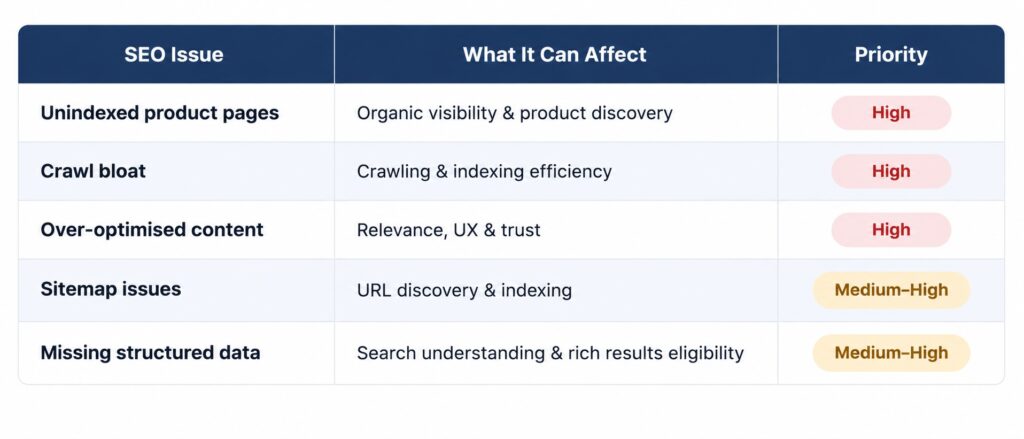
The key lesson is simple: fixing technical SEO isn’t just about pleasing search engines. It’s about removing barriers between your products and potential customers.
How Oshin Web Solution Can Help
Finding these problems manually across a large ecommerce website can be difficult, particularly when hundreds or thousands of product and category URLs are involved.
At Oshin Web Solution, our approach to Ecommerce SEO starts with understanding how your website actually performs—not simply adding keywords to product pages.
Our Ecommerce SEO services can focus on areas such as:
- Technical SEO audits
- Product and category page optimisation
- Indexing and crawlability analysis
- Internal linking improvements
- XML sitemap reviews
- Canonicalisation and duplicate-content issues
- Structured data implementation
- Ecommerce content optimisation
- Competitor and keyword research
- Organic visibility and performance monitoring
The goal isn’t to generate traffic for the sake of traffic. It’s to build a technically sound ecommerce website that can attract relevant visitors who have a genuine reason to buy.
Don’t Let Technical SEO Quietly Cost You Sales
Ecommerce SEO problems are often frustrating because they’re not always obvious.
Your website can look perfectly normal while important product pages remain unindexed. Your navigation can work beautifully for customers while creating thousands of unnecessary URLs. Your sitemap can exist while containing outdated or irrelevant pages.
These are the kinds of issues that can quietly limit organic growth.
The good news is that most can be identified and addressed with the right technical process.
Start by checking your most valuable product and category pages. Review their indexing status, crawl paths, content quality, sitemap presence and structured data. Then work through the wider site systematically.
Strong ecommerce SEO isn’t about doing more. It’s about making sure the important parts of your website can actually be discovered, understood and trusted.
If your ecommerce website isn’t delivering the organic visibility you expect, an SEO audit can reveal what’s happening beneath the surface. Oshin Web Solution can help you identify the technical barriers and build a stronger foundation for sustainable ecommerce growth.
Frequently Asked Questions
1. What is Ecommerce SEO?
Ecommerce SEO is the process of improving an online store’s technical structure, product pages, content and authority to increase relevant organic search visibility and attract potential customers.
2. Why are my ecommerce product pages not ranking?
Product pages may struggle because of indexing problems, thin or duplicate content, weak internal linking, technical issues, competition or poor alignment with search intent.
3. Can duplicate product descriptions hurt Ecommerce SEO?
Yes. Large amounts of duplicated or very similar content can make it harder for search engines to distinguish which pages provide unique value.
4. How often should an ecommerce website have an SEO audit?
There is no single schedule for every store, but regular technical reviews are particularly important for ecommerce websites that frequently add products, change categories or update their site structure.
5. Do ecommerce websites need structured data?
Structured data isn’t a guarantee of higher rankings, but accurate product and other relevant schema can help search engines understand page information and may make eligible pages suitable for enhanced search features.
6. Can Oshin Web Solution help with technical ecommerce SEO?
Yes. Oshin Web Solution provides Ecommerce SEO services covering technical audits, indexing, site structure, product optimisation, structured data, content and other areas that support ecommerce search visibility.

Sandeep Kumar is the founder of Oshin Web Solution and a seasoned digital marketing expert with over 12 years of experience. He specializes in SEO, paid marketing, and online brand growth, helping businesses achieve measurable results in the digital space. When not strategizing campaigns, Sandeep enjoys exploring the latest marketing trends and sharing his insights with the community.