Search is changing quickly.
A few years ago, someone looking for a local business would usually type a keyword into Google, scan the map results or organic listings, visit a website and then decide whether to call. Today, that journey can look very different.
A potential customer might ask ChatGPT, Google AI Mode or another AI-powered search tool:
“Which dentist near me is good for cosmetic dentistry?”
“Can you recommend a reliable plumber in my area?”
“What are the best digital marketing agencies for small businesses in London?”
Instead of receiving only a list of links, they may receive a conversational answer that mentions specific businesses.
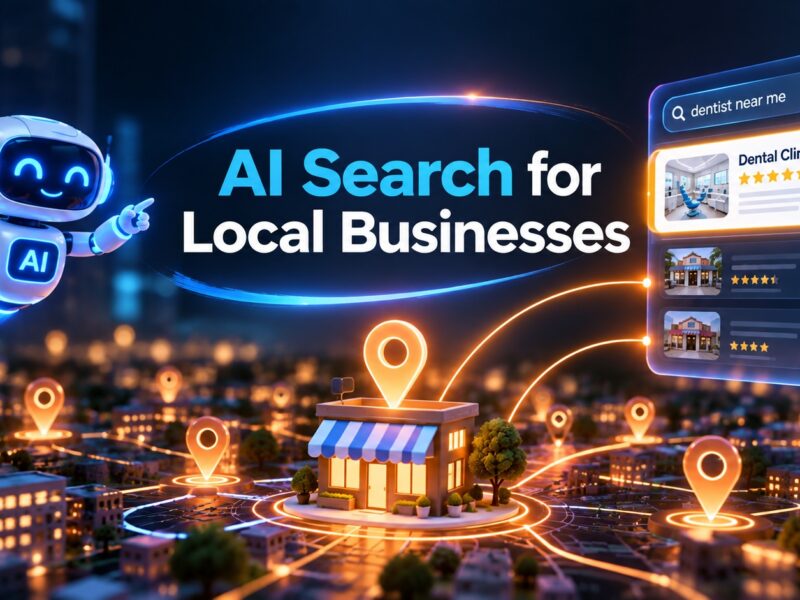
This is why AI search for local businesses has become an important part of digital visibility in 2026.
Google has significantly expanded AI Overviews and AI Mode, while recent local-search research shows that consumers are increasingly using AI alongside Google, Maps and other channels when researching local businesses.
But getting mentioned by AI isn’t the final goal.
The real opportunity is turning that visibility into website visits, phone calls, enquiries, bookings and local customers.
What Is AI Search for Local Businesses?
AI search for local businesses refers to the way AI-powered search experiences discover, understand and potentially recommend local businesses when people ask questions about products or services.
This includes experiences such as:
- Google AI Overviews
- Google AI Mode
- ChatGPT
- Gemini
- Other AI-powered search and assistant platforms
The experience is different from traditional search.
A conventional search might give someone a page of results for “dentist in Manchester.”
An AI search experience may instead answer a more conversational question such as:
“Can you recommend a dentist in Manchester that offers emergency appointments?”
The AI may use information from websites, business profiles, reviews and other online sources to formulate its response.
Recent research by BrightLocal found that Google Maps visibility does not automatically translate into AI visibility. In its study of more than 200,000 local AI searches, business websites were particularly important as sources, accounting for 42% of citations.
That means local businesses need to think beyond rankings alone.
How Is AI Search Different From Traditional Local SEO?
Traditional local SEO is largely concerned with improving your visibility in places such as Google Search and Google Maps.
AI search introduces another layer.
Instead of simply asking:
“What position does my business rank at?”
you also need to consider:
“Does an AI system understand my business well enough to mention it when a potential customer asks a relevant question?”
There is considerable overlap between the two.
Accurate business information, strong reviews, useful service content and a trustworthy online presence can support both traditional local search and AI visibility. However, AI-generated recommendations can vary between platforms and even between different prompts.
LocalPanda’s September 2026 research similarly notes that AI search visibility should be viewed alongside, rather than as a replacement for, traditional local SEO.
This is why businesses should not abandon Google Business Profile or conventional SEO. Instead, they should build a stronger overall search presence.
Why AI Visibility Matters for Local Leads
Imagine someone needs an emergency electrician.
They could search Google, open Maps or ask an AI assistant for recommendations.
If your business is absent from that conversation, another business may receive the enquiry.
This becomes particularly important for businesses where customers make decisions based on location, availability, reputation and trust.
Examples include:
- Dentists
- Plumbers
- Electricians
- Roofers
- Lawyers
- Restaurants
- Salons
- Clinics
- Accountants
- Real estate businesses
- Cleaning companies
- Home improvement companies
- Local professional services
Recent BrightLocal research found that 58% of surveyed consumers had already used AI to find or get a recommendation for a local business. It also found that 75% of AI users went back to Google to verify information before making a decision.
That last point is especially important.
AI visibility and Google visibility aren’t necessarily competing strategies. They can work together.
A customer might discover your business through AI, verify your reviews and location through Google, visit your website and then contact you.
How to Build Strong AI Search Visibility
There is no guaranteed formula for making an AI system recommend a particular business. AI responses can change depending on the platform, query, location and other factors.
However, you can strengthen the information and signals that help people — and search systems — understand your business.
1. Start With Your Google Business Profile
Your Google Business Profile remains an important part of local visibility.
Make sure your profile contains accurate and up-to-date information about:
- Business name
- Address
- Phone number
- Website
- Opening hours
- Business category
- Services
- Photos
- Service areas
- Appointment or booking information
Don’t treat your profile as something you create once and forget.
Keep important information current, add genuine updates where appropriate and make sure your profile reflects what customers will actually find when they contact or visit you.
This also creates a stronger foundation for your wider local SEO services strategy.
2. Keep Your Business Information Consistent
Imagine your website says your business operates at one address, while an online directory shows an old address and another listing has a different phone number.
That creates unnecessary confusion.
Make your core business information consistent across your:
- Website
- Google Business Profile
- Business directories
- Industry websites
- Social profiles
- Local publications
- Review platforms
Name, address and phone information — commonly referred to as NAP — should be accurate wherever your business is represented.
Consistency isn’t about submitting your business to hundreds of random directories.
It’s about ensuring that the important websites describing your business tell the same story.
3. Create Content Around Real Customer Questions
This is one of the biggest opportunities for local businesses.
Don’t create content simply because a keyword has search volume.
Think about the questions customers actually ask.
For example, a roofing company could answer:
- How much does a new roof cost in Birmingham?
- How quickly can an emergency roof repair be completed?
- How often should a roof be inspected?
- What signs mean I need a roof replacement?
A dentist could answer:
- How much do dental implants cost in London?
- What should I do if I have a dental emergency?
- How long does Invisalign treatment take?
- Where can I find an emergency dentist near me?
Start by answering the question clearly, then provide useful supporting information.
This creates content that is helpful to humans while making the subject matter easier for search systems to understand.
4. Build Dedicated Local Service Pages
One generic “Services” page isn’t always enough.
If you offer multiple services in multiple locations, create useful pages around your important combinations.
For example:
Dental implants in Birmingham
Emergency dentist in Leeds
Plumbing services in Manchester
Commercial cleaning in London
But these pages should not be created simply by replacing the city name.
Each location page should contain genuinely useful local information and clearly explain the service.
Thin pages with almost identical wording provide little value to customers.
5. Strengthen Your Reviews and Reputation
Reviews have always been important for local businesses. Their importance doesn’t disappear simply because AI search has arrived.
A potential customer wants to know:
Can I trust this business?
Encourage genuine customers to leave honest feedback and respond professionally to reviews.
Specific reviews can be particularly useful because they may mention the actual service, location or experience.
For example, a review saying:
“The team repaired our boiler in Manchester on the same day.”
provides much more contextual information than:
“Great service.”
Never manufacture reviews or ask customers to make claims that don’t reflect their actual experience.
Your online reputation should represent the real quality of your business.
6. Make Your Website Easy to Understand
Your website is more than a place to display your phone number.
It should clearly communicate:
- Who you are
- What you offer
- Where you operate
- Who you serve
- Why customers choose you
- How customers can contact you
Include clear service pages, location information, team details, FAQs and contact options.
Google has also continued to emphasise the importance of useful, original content and links to websites within its evolving AI Search experiences.
So don’t build a website solely around keywords.
Build a website that genuinely helps customers make decisions.
7. Think About Conversational Searches
AI has changed the way people phrase questions.
Instead of typing:
“best dentist London”
someone may ask:
“Which dentists in London offer Invisalign and have good reviews?”
Instead of:
“SEO agency UK”
they might ask:
“Can you recommend an SEO agency in the UK for a small local business?”
Your content should therefore cover natural questions and longer, specific searches.
This doesn’t mean filling your website with awkward long-tail keywords.
It means understanding the questions behind those searches and providing useful answers.
8. Turn AI Visibility Into Actual Leads
Visibility by itself doesn’t pay the bills.
You need to make it easy for someone who discovers your business to take action.
Your website should have:
- A clearly visible phone number
- Click-to-call functionality on mobile
- Simple enquiry forms
- Clear calls to action
- Online booking where appropriate
- WhatsApp or chat options where useful
- Easy-to-find location information
- Dedicated landing pages for important services
Think about the complete journey:
AI recommendation → Google verification → website visit → trust → enquiry → customer
If the final step is difficult, the value of your visibility decreases.
How Local SEO Services Can Support AI Search
AI visibility shouldn’t be treated as a completely separate marketing activity.
Many of the fundamentals involved in professional local SEO services can support a broader AI visibility strategy.
These can include:
- Google Business Profile optimisation
- Local keyword research
- Website optimisation
- Location landing pages
- Local content
- Citation management
- Review and reputation strategy
- Technical SEO
- Internal linking
- Local authority building
- Conversion optimisation
The difference is that you should now consider how your business information appears across the wider search ecosystem, not only where your website ranks in Google.
How to Measure AI Search Visibility
AI search is still evolving, so measurement isn’t as straightforward as checking a traditional keyword position.
A practical approach is to create a list of realistic customer questions.
For example:
- “Who is the best dentist near me?”
- “Which local dentist offers emergency appointments?”
- “Can you recommend a reliable plumber in [city]?”
- “Which SEO agencies help small businesses in [city]?”
Then periodically test those questions across relevant AI platforms and record:
- Whether your business is mentioned
- How your business is described
- Which competitors appear
- Which sources are cited
- Whether your contact information is accurate
Don’t treat one AI response as a permanent ranking.
Recent research shows that AI recommendations can change between prompts and platforms, making repeated measurement more useful than a single snapshot.
You should also continue monitoring traditional metrics such as:
- Google Maps visibility
- Organic rankings
- Website traffic
- Phone calls
- Form submissions
- Online bookings
- Direction requests
- Conversion rates
Ultimately, leads and customers matter more than an AI visibility score.
Common Mistakes Local Businesses Should Avoid
Focusing Only on Keywords
Keyword optimisation matters, but customers don’t communicate in keyword lists. Build content around their real needs and questions.
Ignoring Google Business Profile
AI search doesn’t mean Google Maps has become irrelevant. Consumers continue to use Google to verify local businesses after discovering them elsewhere.
Creating Thin Location Pages
Changing “London” to “Manchester” across dozens of identical pages isn’t a meaningful local strategy.
Using Fake Reviews
Artificial reviews can damage trust and violate platform policies. Build your reputation through genuine customer experiences.
Forgetting Conversion Optimisation
Getting mentioned by AI but making customers struggle to contact you is a missed opportunity.
Expecting Guaranteed AI Recommendations
No legitimate SEO agency can guarantee that ChatGPT, Google AI Mode or another AI system will recommend your business every time. AI responses can change, and the underlying selection process isn’t fully transparent.
How Oshin Web Solution Can Help
At Oshin Web Solution, we believe the future of local marketing isn’t about choosing between traditional SEO and AI search.
It’s about building a strong digital presence that works across the places where potential customers are looking.
Our approach can combine local SEO services, website optimisation, Google Business Profile optimisation, content strategy, reputation building and emerging AI-search optimisation.
The objective isn’t simply to chase an AI mention.
It’s to make sure your business has accurate information, useful content, strong local relevance and a website that can turn visibility into genuine enquiries.
Whether you’re a dentist, home-service company, professional service provider, retailer or another local business, your strategy should begin with understanding how your customers search and what they need to see before they decide to contact you.
Conclusion
The local search journey is becoming more complex.
Customers may discover a business through Google Search, Google Maps, social platforms or an AI assistant. They may then move between several of these channels before making a decision.
That means businesses can’t afford to think about visibility as just a Google ranking anymore.
AI search for local businesses is becoming another part of the discovery journey, but it works alongside traditional local SEO rather than replacing it.
The fundamentals still matter: accurate business information, a strong website, useful content, genuine reviews, local relevance and a clear path to conversion.
The businesses that bring these pieces together can create something much more valuable than visibility alone — a search presence that helps turn local discovery into real customers.
Frequently Asked Questions
1. What is AI search for local businesses?
It refers to how AI-powered search platforms discover, understand and potentially recommend local businesses when people ask conversational questions about products or services.
2. Is AI search replacing local SEO?
No. Traditional local SEO and AI search visibility overlap, but they are not the same. Google Maps and organic search remain important, while AI search adds another discovery channel.
3. How can my business appear in AI search results?
Start with accurate business information, a well-optimised website, useful service content, genuine reviews and consistent information across trusted online sources. There is no guaranteed method for securing a specific AI recommendation.
4. Do Google Business Profile and Google Maps still matter in 2026?
Yes. Current research shows that consumers continue to use Google and Maps to discover and verify local businesses, even when AI is part of the initial search journey.
5. What are local SEO services?
Local SEO services can include Google Business Profile optimisation, local keyword research, website optimisation, citations, local content, reputation management and strategies designed to improve visibility in specific locations.
6. Can small businesses benefit from AI search?
Yes. A smaller local business can build strong visibility by providing accurate information, demonstrating genuine expertise, earning authentic reviews and creating specific content that answers the questions its customers actually ask.
7. How do I know whether my business is appearing in AI search?
Create realistic customer questions and test them regularly across relevant AI platforms. Record whether your business is mentioned, how it is described and which competitors and sources appear.
8. Should I invest in AI SEO or traditional SEO first?
For most local businesses, the fundamentals should come first: a technically sound website, accurate business information, Google Business Profile optimisation, useful content and genuine reviews. These foundations can support both traditional local SEO and AI visibility.
https://twitter.com/OshinWebSoln9. Can Oshin Web Solution help with local and AI search visibility?
Yes. Oshin Web Solution can combine local SEO, website optimisation, Google Business Profile work, content strategy and AI-search-focused optimisation to build a broader local visibility strategy.
Want more digital marketing tips, SEO insights & growth strategies? Follow Oshin Web Solution on Facebook, Twitter, LinkedIn, Instagram & YouTube to stay connected and grow with us.

Sandeep Kumar is the founder of Oshin Web Solution and a seasoned digital marketing expert with over 12 years of experience. He specializes in SEO, paid marketing, and online brand growth, helping businesses achieve measurable results in the digital space. When not strategizing campaigns, Sandeep enjoys exploring the latest marketing trends and sharing his insights with the community.