The way people search online is changing faster than ever before. A few years ago, most buying journeys started with Google. Today, millions of people open ChatGPT to ask detailed questions, compare products, research services, and even shortlist companies before making a purchase.
This shift is creating an entirely new advertising landscape.
With ChatGPT Ads already rolling out in selected countries and expanding to more regions, businesses that rely on online visibility need to start paying attention. Just as Google Ads transformed digital advertising two decades ago, AI advertising has the potential to reshape how brands reach customers over the next few years.
If your business invests in digital marketing services, understanding this change early could give you a significant competitive advantage.
In this guide, we’ll explain how ChatGPT Ads work, why they matter, how they compare with Google Ads, and what businesses should do to prepare for the future.
Why ChatGPT Ads Matter More Than You Think
Consumers are no longer searching using only short keywords.
Instead of typing:
“SEO agency”
People now ask:
- Which SEO agency is best for a manufacturing company?
- What is the best digital marketing agency for B2B businesses?
- Which SEO company offers affordable services for startups?
This conversational style gives AI much more context about what users actually want.
That means advertising is becoming less about matching keywords and more about matching intent.
For businesses, this is a major opportunity.
What Are ChatGPT Ads?
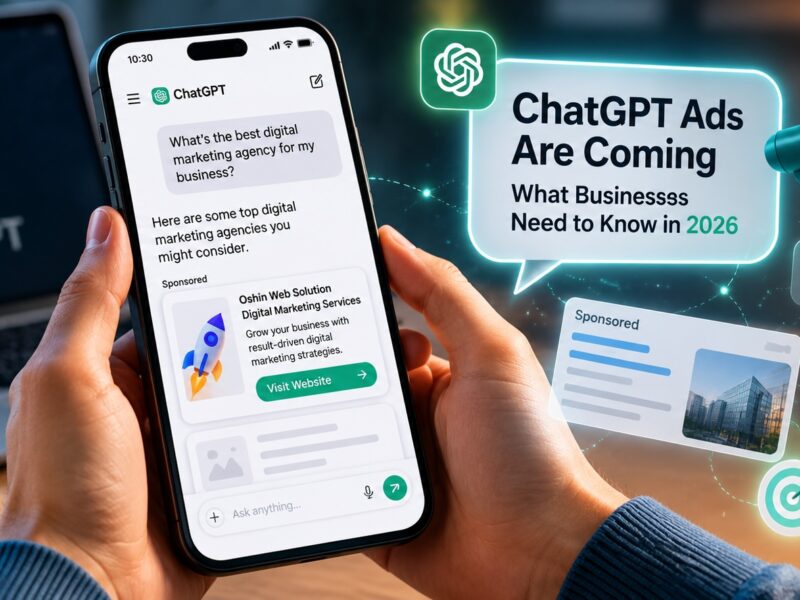
ChatGPT Ads are sponsored recommendations that appear inside ChatGPT conversations whenever they’re relevant to a user’s question.
Unlike traditional banner advertising, these advertisements are designed to feel helpful rather than disruptive.
They are clearly labelled as sponsored recommendations while remaining separate from the assistant’s organic response.
A typical ChatGPT advertisement may include:
- Advertiser name
- Company logo
- Headline
- Short description
- Image
- Landing page
- Call-to-action button
Instead of interrupting users, these ads appear when someone is actively researching products or services, making them far more context-aware than many traditional advertising formats.
Why Is OpenAI Introducing AI Advertising?
Running large AI systems requires enormous computing resources and infrastructure.
Introducing AI advertising helps OpenAI support free and lower-cost plans while continuing to improve platform performance and expand access for users worldwide.
Beyond funding, another reason is simple:
People are increasingly using ChatGPT as a shopping assistant, business advisor, research tool, and product discovery platform.
Where users spend time researching, advertisers naturally follow.
How ChatGPT Ads Work
Unlike traditional search engines that mainly rely on keywords, ChatGPT understands complete conversations.
When someone asks:
“Can you recommend an affordable SEO company that works with UK businesses?”
The AI understands:
- Business type
- Budget
- Country
- Service needed
- User intent
If an advertiser has created a campaign targeting similar conversations, ChatGPT may display a sponsored recommendation beneath the answer.
Importantly, advertisers do not gain access to private conversations. The system uses contextual signals while maintaining user privacy.
Types of ChatGPT Ads Businesses Can Expect
As the platform evolves, several ad formats are expected to become common.
Sponsored Recommendations
These are the most familiar format.
They appear below AI-generated responses and recommend businesses, products, or services related to the user’s query.
For example:
A user asks:
“Who offers reliable SEO services for ecommerce websites?”
ChatGPT may show one or more sponsored agencies beneath the response.
Product Recommendation Cards
When users search for products, ChatGPT may display recommendation cards including:
- Product image
- Price
- Ratings
- Features
- Purchase button
This creates a smoother buying experience directly inside conversations.
Conversational Display Ads
Rather than interrupting the experience, these ads blend naturally into ongoing conversations while remaining clearly marked as sponsored content.
Because they’re context-aware, they often feel more relevant than traditional display advertising.
Who Should Invest in ChatGPT Ads?
The short answer is almost every business that already invests in online marketing.
However, some industries stand to benefit more than others.
B2B Companies
Businesses selling software, consulting, manufacturing services, legal solutions, or enterprise products often have long buying cycles.
ChatGPT excels at handling detailed research questions, making it an ideal environment for B2B lead generation.
B2C Brands
Consumers increasingly ask AI:
- Which smartphone should I buy?
- What’s the best skincare brand?
- Which running shoes are worth the money?
Brands appearing during these conversations gain valuable visibility before purchase decisions are made.
Local Businesses
- Restaurants
- Dental clinics
- Home service providers
- Real estate agencies
- Fitness centers
- Medical practices
These businesses can benefit as AI becomes better at recommending nearby services.
High-Value Service Businesses
Industries involving expensive decisions naturally require more research.
Examples include:
- Digital marketing agencies
- Software providers
- Financial advisors
- Property consultants
- Luxury products
- Healthcare services
These businesses are likely to see strong opportunities from conversational advertising.
ChatGPT Ads vs Google Ads
Both platforms help businesses reach potential customers, but they work very differently.
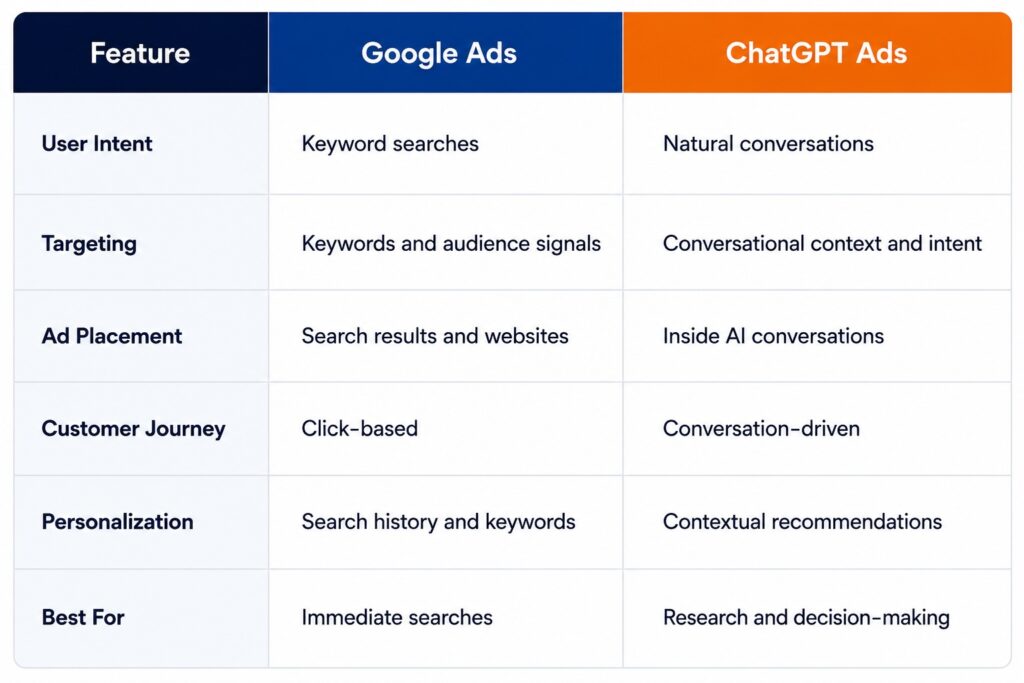
This doesn’t mean one platform replaces the other.
Instead, businesses will likely use both together as part of a broader digital marketing strategy.
Possible Bidding Models for ChatGPT Ads
Although the platform is still evolving, businesses can expect several familiar bidding options.
Cost Per Click (CPC)
Advertisers pay only when users click their ad.
Ideal for:
- Lead generation
- Website traffic
- Service enquiries
Cost Per Acquisition (CPA)
Businesses pay based on completed actions such as:
- Contact forms
- Purchases
- Bookings
- Software trials
This model is especially valuable for B2B companies.
Cost Per Mille (CPM)
Useful for:
- Brand awareness
- Product launches
- New market expansion
Advertisers pay per thousand impressions.
Value-Based Bidding
AI can identify conversations likely to generate higher-value customers.
Instead of treating every lead equally, campaigns can prioritize users most likely to convert into profitable clients.
How AI Advertising Differs from Traditional PPC
Traditional PPC focuses heavily on keywords.
AI advertising focuses on conversations.
That difference changes everything.
Instead of trying to rank for:
“SEO agency”
Businesses now need content capable of answering questions like:
- Which SEO agency has experience with ecommerce brands?
- Who provides affordable SEO for UK companies?
- What is the best digital marketing agency for manufacturers?
Winning AI advertising requires understanding customer intent rather than simply targeting search phrases.
Challenges Businesses Should Know About
Every new advertising platform comes with uncertainty.
Some challenges include:
Limited Historical Data
- Businesses won’t initially have years of performance data to guide campaign decisions.
AI Context
- AI must correctly understand user conversations before showing relevant ads.
- Advertisers will need to monitor campaign quality closely.
Privacy Regulations
- AI platforms continue strengthening privacy protections.
- This means targeting methods may differ significantly from traditional advertising networks.
Attribution Complexity
Users may:
- See an ad today
- Visit the website tomorrow
- Search Google next week
- Convert several days later
Measuring these journeys accurately will become increasingly challenging.
How Businesses Should Prepare for ChatGPT Ads
Early preparation can make a huge difference once advertising becomes widely available.
1. Improve Website Content
AI prefers websites with:
- Clear headings
- Helpful answers
- Strong expertise
- Updated information
- Logical structure
High-quality content benefits both SEO and AI advertising.
2. Invest in GEO Alongside SEO
- Generative Engine Optimization (GEO) helps AI understand and trust your content.
- Businesses that already appear naturally in AI-generated answers may also enjoy stronger relevance for future advertising.
3. Write More Conversational Content
- Move beyond keyword stuffing.
- Create content that answers real customer questions.
- Think like your audience rather than search engines.
4. Strengthen Landing Pages
When someone clicks a ChatGPT advertisement, the landing page should immediately:
- Build trust
- Explain the offer
- Show testimonials
- Present clear calls to action
Better landing pages mean higher conversion rates.
5. Align SEO, PPC and AI Advertising
Treat these channels as one connected strategy rather than separate campaigns.
At Oshin Web Solution, we believe the future belongs to businesses that integrate:
- SEO
- GEO
- PPC
- Content marketing
- AI search optimization
- Conversion optimization
Together, these create a stronger digital presence than any single channel alone.
Will ChatGPT Ads Replace Google Ads?
Probably not.
Google still handles billions of searches every day and remains one of the most effective advertising platforms available.
However, ChatGPT is introducing something Google never truly offered:
Advertising based on complete conversations.
Rather than replacing Google Ads, ChatGPT Ads will likely become another essential channel within a modern digital marketing strategy.
Businesses that diversify across both platforms will be better positioned as consumer behavior continues evolving.
The Future of AI Advertising
We’re only at the beginning of conversational advertising.
Over the next few years, we can expect:
- Smarter AI targeting
- Better personalization
- More interactive ad formats
- Improved reporting
- Stronger integration with ecommerce
- Advanced conversion tracking
As AI becomes a larger part of everyday decision-making, brands that adapt early will have a significant advantage over competitors who wait.
The future isn’t about choosing between Google and ChatGPT—it’s about understanding how customers move between both.
Conclusion
The arrival of ChatGPT Ads marks one of the biggest changes in online advertising since the launch of Google Ads. Consumers are increasingly relying on AI to research products, compare services, and make informed purchasing decisions, creating new opportunities for businesses to connect with highly motivated audiences.
Rather than viewing AI advertising as a replacement for existing channels, smart businesses should see it as the next evolution of digital marketing. By combining SEO, GEO, PPC, quality content, and conversational advertising, brands can build stronger visibility across both search engines and AI platforms.
At Oshin Web Solution, we help businesses stay ahead of digital trends through result-driven digital marketing servicesthat combine SEO, PPC, AI search optimization, content marketing, and future-ready strategies. Whether you’re preparing for ChatGPT Ads or looking to strengthen your overall online presence, our team can help you build a marketing strategy designed for 2026 and beyond.
Frequently Asked Questions
What are ChatGPT Ads?
ChatGPT Ads are sponsored recommendations that appear within ChatGPT conversations. They are clearly labeled as advertisements and are shown when relevant to a user’s query, helping businesses reach people with high purchase intent.
How are ChatGPT Ads different from Google Ads?
Google Ads primarily target keywords entered into search engines, while ChatGPT Ads focus on conversational intent. They appear within AI-generated discussions, offering recommendations based on the context of a user’s questions.
Who should use AI advertising?
Businesses of all sizes can benefit from AI advertising, especially B2B companies, ecommerce brands, local businesses, SaaS providers, healthcare services, financial firms, and agencies looking to reach high-intent audiences.
Will ChatGPT Ads replace Google Ads?
No. ChatGPT Ads are expected to complement rather than replace Google Ads. Using both platforms together can help businesses reach customers at different stages of the buying journey.
How can businesses prepare for ChatGPT Ads?
Businesses should strengthen their website content, improve SEO and GEO, create conversational content, optimize landing pages, and integrate AI advertising into their overall digital marketing strategy.
What metrics will likely be important for ChatGPT Ads?
Advertisers can expect to monitor key performance metrics such as impressions, clicks, click-through rate (CTR), cost per click (CPC), cost per acquisition (CPA), conversions, and return on ad spend (ROAS).
How can Oshin Web Solution help businesses prepare for AI advertising?
Oshin Web Solution provides comprehensive digital marketing services, including SEO, PPC management, content marketing, GEO, AI search optimization, and conversion-focused strategies to help businesses stay competitive as ChatGPT Ads and other AI advertising platforms continue to evolve.
Follow Us On: Facebook, Twitter, LinkedIn, Instagram & YouTube.

Sandeep Kumar is the founder of Oshin Web Solution and a seasoned digital marketing expert with over 12 years of experience. He specializes in SEO, paid marketing, and online brand growth, helping businesses achieve measurable results in the digital space. When not strategizing campaigns, Sandeep enjoys exploring the latest marketing trends and sharing his insights with the community.